Chimney Cat
Games
Presents
TUNNEL STORY
LOOT STORY
The glue of greed that binds the game.
Loot is the reward and greed economy of Tunnel Story.It supports the game's JRPG loop by letting players recover, adapt, and grow stronger through play. But Loot is not just a deck of treasures. It is a core part of the game’s pressure mechanics. Useful cards, progression items, and junk cards all compete for the same limited carry space in your hand.The Loot system is split into two entirely separate decks: Mini Loot (mini cards) and Rare Loot (poker size cards).Mini Loot supports the Party. Rare Loot reshapes the Relic.
Let's check out the 5 Visible Parts of a Loot Card.
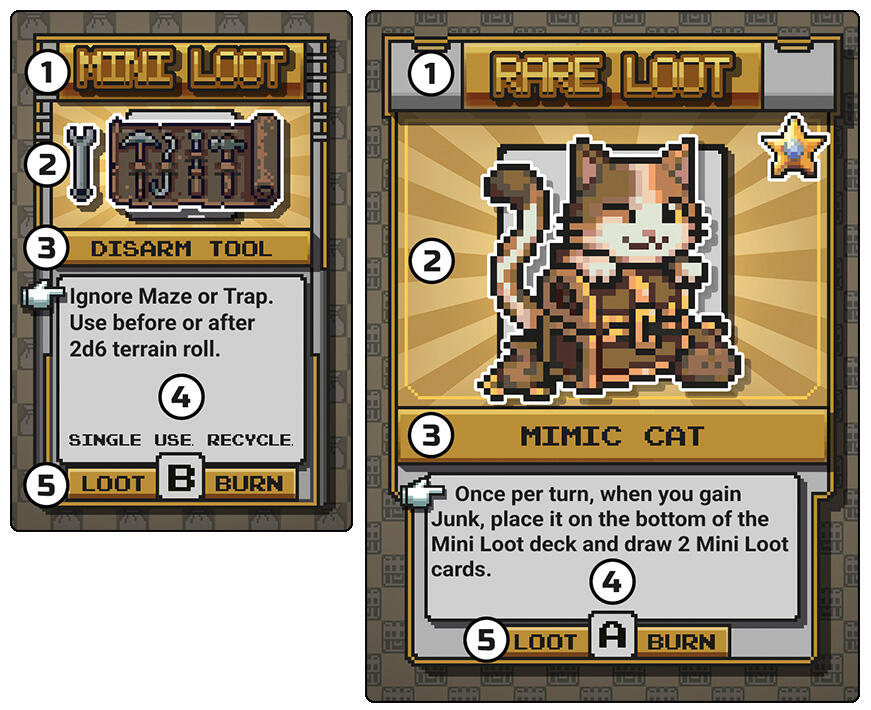
1. Loot Class (Top Left)
2. Profile Picture/Icon (Middle Left)
3. Name (Middle)
4. Card Body (Middle)
5. Loot Burn (Bottom)

1. Loot Class (Top Left) Identifies the exact category of the item.
◾Mini Loot contains 6 classes: Heal, Warp, Party, Pack, Utility, and Chaos.
◾Rare Loot contains 6 classes: Relic, Mastery, Color, Pack, Pet, and Terrain.
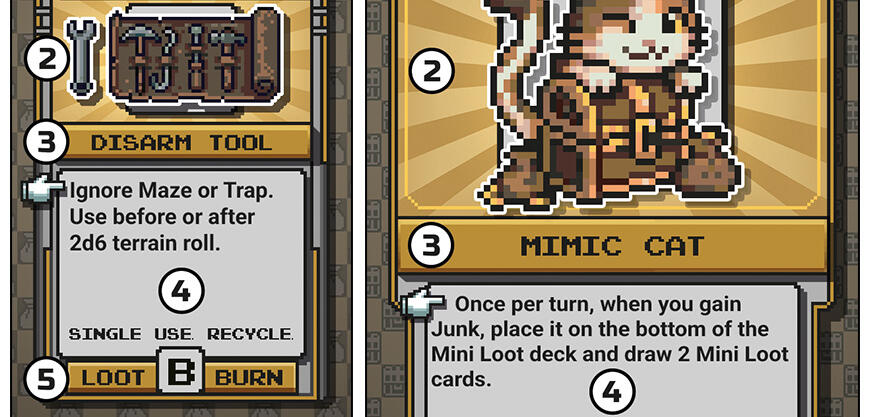
2. Profile Picture/Icon (Middle Left) The visual representation of what the item or effect looks like.
3. Name (Middle Left) The title of the item. Mini Loot names are practical and repeatable, while Rare Loot names are memorable and unique.
4. Card Body: Rules & Placement (Middle) A short, direct explanation of what the card does and where it goes when used.A Loot card will either:◾Have no placement and recycle after use
◾Place by your Relic as an ongoing upgrade
◾Place on the board as a temporary terrain effect

5. Loot Burn (Middle Left)
The Combat Connection: Every Loot card features a randomized directional icon. During a Duel, you can Burn the card from your hand to gain that exact input in your dice pool. Because this symbol is a 1-in-6 chance, players must actively hunt for and hold Loot that covers the specific directions their party struggles to roll.
THE MINI LOOT SYSTEM
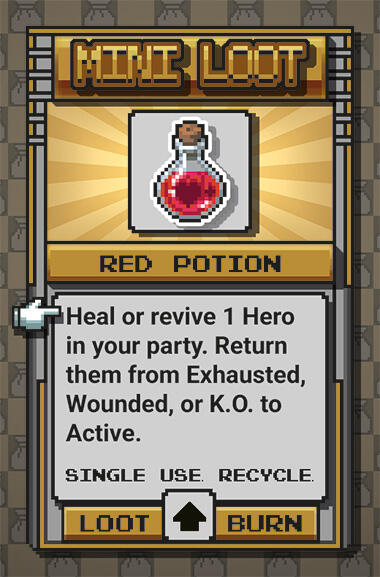
Mini Loot represents your daily reward economy. It is common, mostly temporary, and tradeable. It is intentionally repetitive so it stays fast to read and dependable under pressure. To physically separate it from major rewards, Mini Loot uses mini cards.
The Mini Loot deck contains 48 cards divided into six groups:
◾Heal: The backbone of the deck. Red Potions restore Heroes from Exhausted, Wounded, or KO states.
◾Warp: Camp Warp and Town Warp allow you to teleport your party to safety.
◾Party: Controls recruit, retire, and Hero exchange. Recruitment Flyers and Bribes let you recruit new Heroes, retire K.O. ones, or swap Heroes with other players.
◾Pack: Backpacks increase your hand size by 3, but you are strictly limited to a maximum of 2 Backpacks per player. If you draw a 3rd Backpack, you must discard it and immediately draw 1 Mini Loot card. Backpacks can only be traded if the receiving player holds fewer than 2 Backpacks.
◾Utility: Items like Trail Sense, Hunter’s Eye, Cleanse, and Disarm let you scout decks, remove curses, or ignore traps.
◾Chaos (Junk & Mimics): Introduces greed pressure and risk. Mimics trigger sudden monster fights. If you win, you claim the monster’s reward. Afterward, the Mimic is sent to the bottom of the deck. Junk intentionally clogs your hand until cleared.
THE RARE LOOT SYSTEM
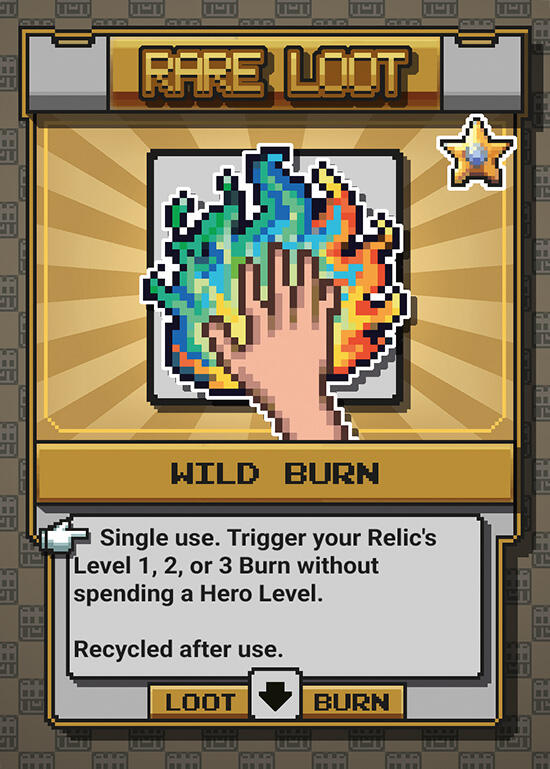
Rare Loot is the game’s Relics reward layer. It provides major upgrades, companions, and system-bending effects. Rare Loot uses the standard poker-card format and is earned through Mini-Bosses, End Bosses, or skill-based drops through Crit reward access. When fighting normal monsters, pushing your luck to complete their hardest combo tier grants access to stronger loot outcomes.Unlike Mini Loot, Rare Loot is Soulbound. It is not tradeable and not sellable. It is entirely personal to your build.The Hard Cap: Each player may have a maximum of 1 Rare Loot cards total. If you gain a 2nd Rare Loot card while at the limit, you must reveal it, choose 1 to keep, and place the remaining card on the bottom of the deck.
The Rare Loot deck contains 24 cards divided into six groups:
◾Relic (Wild Burns): Single-use loot that let you trigger your Relic’s Level 1, 2, or 3 Burn without spending a Hero level.
◾Mastery: Permanent upgrades placed by your Relic that give you bonus Kombo Dice against specific monster species and double their cash-in value.
◾Color: Color Cores permanently increase your active Color Dice Pool by 1.
◾Pack: High-tier inventory management. These Relic upgrades allow certain items, like Junk, Potions, or Monsters, to no longer count toward your hand size.
◾Pet: Persistent JRPG-style companions that sit by your Relic and provide ongoing effects. For example, the Fairy allows you to use Junk cards as Red Potions, while the Mimic Cat converts gained Junk into double mini loot card draws.
◾Terrain: Temporary special terrain cards you place directly onto the board to alter routes. These landmarks are powerful, but they may drift across the map.
HAND PRESSURE: The Greed Trap
Loot is one of the main ways Tunnel Story expresses greed. By default, your hand size is strictly limited to 5 cards. Useful Loot, captured Monsters, and junk cards all compete for that same space. Useful cards tempt players to carry more. Junk punishes over-extension.
Junk, Co-Op Scaling & The Deck Cycle
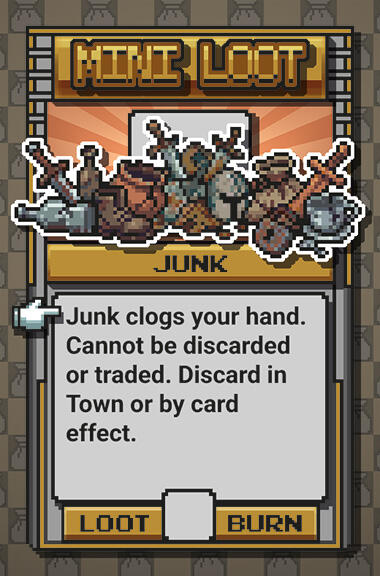
Junk is the main chaos pressure in the Loot system. It clogs hand space and cannot be freely discarded. The Loot system is balanced for solo first. In co-op, hand pressure grows naturally because more players draw more cards, spreading Junk across the game.Crucially, when you clear Junk or survive a Mimic, those cards do not go to a discard pile. They are placed at the bottom of the Mini Loot deck. This ensures that cleared pressure will eventually return to hunt you if the run goes long enough.
TOWNS, SHOPS & TRADE LOGISTICS
To survive a clogged hand, you must navigate the map.Trading Restrictions: You cannot freely trade items or Heroes while exploring the overworld. You may only exchange cards with other players when your party reaches a Camp or Town.◾Town: The primary cleanup hub where you can safely clear Junk, reset hand pressure, trade gear, remove curses, and fully stabilize before pushing forward again.◾Shop (Fixing the RNG): Converts held value into needed value. The Shop is where you cash in held Monster Hostages for progression or Mini Loot. It also allows you to exchange same-tier Monsters for a specific species. If you are drawing the wrong Monsters for your Hero’s Level-Up recipe, the Shop is how you fix your luck.
PLAYING LOOT WELL: Tactical Questions
Do not treat every Loot card the same. Loot is not only about what you gain. It is also about what you keep, what you cash in, and what you discard.During a run, constantly ask yourself:◾When do I use this card, and when do I hold it to Burn for its specific combat direction?
◾Is my hand too full? Do I need to route to a Town to clear pressure and trade?
◾When is the right time to exchange my Monsters at a Shop to level up my Hero?
◾How do I build my party around the Rare Loot I just discovered?Loot rewards smart carry decisions, not just lucky draws.
That is the Loot system of Tunnel Story. This is the survival economy of every run, turning rewards into pressure, greed into risk, and smart carry decisions into long-term advantage. Learn what to use, what to hold, and what to discard before your own hand becomes the trap.
Coming Soon! Updated Art - Over World Icons
Hope you are enjoying your crisp autumn breeze!
Chimney Cat team
(Note: All cards/rules are subject to change before final release)
If you missed our campaign, don't dismay! Just click the cart.
© 2026 Chimney Cat Games Ltd. All rights reserved.